Showing posts with label 1955. Show all posts

Sunday, April 7, 2024

#120 Lon Warneke - Chicago Cubs


Lonnie Warneke
Chicago Cubs
Pitcher

Bats:
  Right  Throws:  Right  Height:  6'2"  Weight:  185
Born:  March 28, 1909, Mount Ida, AR
Major League Teams:  Chicago Cubs 1930-1936; St. Louis Cardinals 1937-1942; Chicago Cubs 1942-1943, 1945
World Series Appearances:  Chicago Cubs 1932, 1935
Died:  June 23, 1976, Hot Springs, AR (67)

Lon Warneke spent his entire 15-year career with the Cubs and Cardinals, and was a 20-game winner in three seasons in the early 1930s.  Warneke joined the Cubs' starting rotation in 1932, going 22-6 while leading the league with a 2.37 ERA.  With no Cy Young Award yet for the league's top pitcher, Warneke finished second that season in the league's MVP voting behind Chuck Klein (#139).  He'd lead the league in complete games in 1933 with 26 and pitched four innings of relief for the National League All-Stars in the first All-Star Game.  Warneke holds the distinction of collecting the first triple and scoring the first National League run in All-Star Game history.  He was a 20 game winner again in 1935, helping the Cubs to their second pennant in four years.

Warneke continued his success with the Cardinals following an October 1936 trade to St. Louis.  He won 18 games in 1937, and 17 games in 1941, while also throwing a no-hitter against the Reds on August 30, 1941.  He retired following the 1945 season with a lifetime record of 192-121 and a 3.18 ERA in 445 pitching appearances.  Warneke recorded 1,140 career strikeouts.  He became an umpire in the Pacific Coast League in 1946, and joined the ranks of National League umpires in 1949, resigning the position following the 1955 season.  Warneke is the only person to have played and umpired in both an All-Star Game and a World Series game in major league history.

Building the Set
December 11, 2020 from San Diego, CA (Kit Young Cards)
On the night I impulsively decided to collect the original Diamond Stars set, and I subsequently purchased the Harvey Hendrick (#41) card from Kit Young Cards, I also added the complete, and first, extended set to my cart for the very reasonable price of $7.50.  The 12 cards in this first extended set were originally issued in 1981.

In the early 1980s, a family member of a former National Chicle employee discovered an uncut sheet of 12 unused cards presumably meant as a 1937 continuation of the Diamond Stars set.  As originally advertised, and as mentioned on the back of every card issued, the company had intended for the set to contain 240 subjects.  They only produced 108 cards before production was halted, and the theory is this newly found sheet represented a "lost" continuation of the set.  Fortunately, the images of the cards made their way into the collecting world and a 12-card "what if" set was created.  (More on the uncut sheet can be found here from SABR's Baseball Cards Research Committee and from this Ryan Cracknell article for Beckett.)

Another great article was recently published to SABR's Baseball Cards Research Committee website taking a closer look at these extended cards.

The Beckett online database lists the set as "1981 Diamond Stars Continuation Den's" and the set's description notes "This set was created and produced by Denny Eckes.  Hobbyist Mike Galella was involved in bringing this sheet to the the public.  These cards were originally available from the producer for $3."  The back of the cards have a 1981 copyright attributed to Den's Collectors Den, the company belonging to the aforementioned Eckes.

The 12 cards include more ambitious geometric designs than the original Diamond Stars cards,  although the overall color template remains the same as their 1934 to 1936 counterparts.

Variations Available
1 - 1981 / blue back / 1936 statistics / 1981 copyright

The Card / Cubs Team Set
If this card was intended to have been released in 1937, the write-up on the back would have indicated Warneke had recently joined the Cardinals - see below.  Thematically consistent with the original Diamond Stars set, the tip on the back encourages pitchers to know how to field their position and to know where to position himself for each potential scenario when a ball is put into play.

1937 Season
On October 8, 1936, the Cubs traded Warneke to the Cardinals for Ripper Collins (#116) and Roy Parmelee.  He'd initially slot in as the Cardinals' number three starter behind Dizzy Dean (#124) and Si Johnson, with Warneke eventually outperforming them both.  He'd go 18-11 with a 4.53 ERA in 36 games, while throwing 18 complete games and a pair of shutouts.

1933 Goudey #203
1933 DeLong Grum #16
1939 Play Ball #41
1940 Play Ball #114
1955 Bowman #299

Other Notable Baseball Cards
First Mainstream Card:  1933 Goudey #203
Topps Flagship Set Appearances (0):  N/A
Most Recent Mainstream Card:  1994 Conlon Collection TSN #1106

71 - Warneke non-parallel baseball cards in the Beckett online database as of 4/6/24.

Sources:

Sunday, June 18, 2023

#15 Dick Bartell - Philadelphia Phillies


Richard William Bartell
Philadelphia Phillies
Outfield

Bats:  Right  Throws:  Right  Height:  5'9"  Weight:  160
Born:  November 22, 1907, Chicago, IL
Major League Teams:  Pittsburgh Pirates 1927-1930; Philadelphia Phillies 1931-1934; New York Giants 1935-1938; Chicago Cubs 1939; Detroit Tigers 1940-1941; New York Giants 1941-1943, 1946
World Series Appearances:  New York Giants 1936-1937; Detroit Tigers 1940
Died:  August 4, 1995, Alameda, CA (87)

An aggressive and fiery competitor, Dick Bartell was a veteran of 18 big league seasons, known for his ability to hit for average and his above average defense at shortstop.  Bartell played his first four seasons with the Pirates, making his big league debut at the age of 19.  He blossomed with the Phillies, serving as one of the few bright spots on an otherwise bleak roster.  Bartell led the league in 1932 and 1933 in sacrifices and was one of the Phillies' first All-Stars in 1933.  Bartell started and played shortstop in the first ever All-Star Game, joining teammate Chuck Klein (#139) who started in right field.  Dealt to the Giants following the 1934 season, Bartell would enjoy his finest seasons in New York.

He helped the club reach the World Series in 1936 and 1937, although they fell to the Yankees both times. Those were Bartell's best seasons as he batted .298 with 42 RBIs in 1936 and .306 with 14 home runs and 62 RBIs in 1937.  Despite his numbers, Bartell's combative disposition led to his frequent trades and he also led the league in getting hit by pitches a stunning five times.  He'd return to the Giants for five games in 1946, after serving two years in the Army during World War II, and then retire as a player.  Bartell played in 2,016 big league games and had a lifetime average of .284 with 2,165 hits.  He led all shortstops in putouts and assists in three seasons and in double plays turned in four seasons, and his name is often mentioned as one of the best, and most underrated, shortstops of his era.  His lifetime fielding percentage was .952.  Bartell managed in the minor leagues in the 1940s and 1950s, and served on the big league coaching staffs of the Yankees (1946), Tigers (1949-1952) and Reds (1954-1955).

Building the Set
June 10, 2023 from San Diego, CA (Kit Young Cards) - Card #82
I hadn't added any new cards to this set since mid-March, and I was lamenting the lack of activity on this blog in early June when I decided to rectify both issues.  Taking advantage of a sale from Kit Young Cards, I added this Bartell card, the Shanty Hogan card (#20), and Bartell's 1955 Bowman card during a particularly bleak day in my office while on a needed mental health break.  I was surprised to find this Bartell card at the price being offered, as the Phillies version of this card has eluded me for a few years.  The Giants version of the card (see below) seems to be way more readily available than the Phillies version.  With the addition of this card, my Phillies team set is complete, joining the Browns, Senators and Dodgers as the first four Diamond Stars team sets completed.

Variations Available
1 - 1934 / green back / 1933 statistics / 1934 copyright / team on back is the Phillies ✅
2 - 1935 / green back / 1934 statistics / 1934 copyright / team on back is the Giants

The Card / Phillies Team Set
This is the third of three Bartell cards needed for my version of the set.  The first two are both #15, with the version released in 1934 (this version) noting his team as the Phillies (actually the Nationals) on the back.  The version released in 1935 updates the back to reflect his trade to the Giants.  Finally, Bartell is also card #101 in the set, and that version, released in 1936, removes the Phillies logos from the photo on the front.  The tip on the back of the card explains the need for a shortstop to vary his throws depending on the angle of a batted ground ball and the speed of the baserunner.

1934 Season
In his final season with the Phillies, Bartell was once again their everyday shortstop.  He batted .310 with nary a home run, 37 RBIs and 13 stolen bases.  Bartell started 146 of the Phillies' 149 games at shortstop, with Mickey Haslin briefly filling in for him for a three-game stretch in late May.  His .384 on-base percentage was 10th best in the league.  In the field, Bartell led all shortstops with assists (483) and double plays turned (93).  On November 1st, he was traded to the Giants for John Pezzzullo, Blondy Ryan (#40), Johnny Vergez (#21), George Watkins and cash.

Phillies Career
The Phillies acquired Bartell from the Pirates on November 6, 1930 for Tommy Thevenow and Claude Willoughby.  With the nickname "Rowdy Richard," Bartell was perhaps the first in a long line of scrappy shortstops to come through Philadelphia.  He was the team's opening day and primary shortstop between 1931 and 1934, establishing himself as one of the best at that position in the game.  Bartell led all National League shortstops in assists in 1932 and 1934, in putouts between 1932 and 1934, and was in the top ten for fielding percentage between 1932 and 1934.  Named as the starting shortstop for the first All-Star Game in 1933, Bartell batted seventh and went 0 for 2, striking out in his first at-bat against Lefty Gomez (#118).  In 587 games with the Phillies, Bartell batted .295 with 695 hits, 386 runs scored, 146 doubles and 161 RBIs.  As mentioned above, he was dealt to the Giants following the 1934 season.

1933 Goudey #28
1933 George C. Miller (R300)
1933 Tattoo Orbit (R305)
1938 Goudey Heads-Up #272
1955 Bowman #234

Other Notable Baseball Cards
First Mainstream Card:  1933 Goudey #28
Topps Flagship Set Appearances (0):  N/A
Most Recent Mainstream Card:  1994 Conlon Collection TSN #1243

66 - Bartell non-parallel baseball cards in the Beckett online database as of 6/11/23.

Sources:

Sunday, March 6, 2022

#101 Dick Bartell - New York Giants


Richard William Bartell
New York Giants
Shortstop

Bats:
  Right  Throws:  Right  Height:  5'9"  Weight:  160
Born:  November 22, 1907, Chicago, IL
Major League Teams:  Pittsburgh Pirates 1927-1930; Philadelphia Phillies 1931-1934; New York Giants 1935-1938; Chicago Cubs 1939; Detroit Tigers 1940-1941; New York Giants 1941-1943, 1946
World Series Appearances:  New York Giants 1936-1937; Detroit Tigers 1940
Died:  August 4, 1995, Alameda, CA (87)

An aggressive and fiery competitor, Dick Bartell was a veteran of 18 big league seasons, known for his ability to hit for average and his above average defense at shortstop.  Bartell played his first four seasons with the Pirates, making his big league debut at the age of 19.  He blossomed with the Phillies, serving as one of the few bright spots on an otherwise bleak roster.  Bartell led the league in 1932 and 1933 in sacrifices and was one of the Phillies' first All-Stars in 1933.  Bartell started and played shortstop in the first ever All-Star Game, joining teammate Chuck Klein (#139) who started in right field.  Dealt to the Giants following the 1934 season, Bartell would enjoy his finest seasons in New York.

1934-36 Diamond Stars #15
He helped the club reach the World Series in 1936 and 1937, although they fell to the Yankees both times. Those were Bartell's best seasons as he batted .298 with 42 RBIs in 1936 and .306 with 14 home runs and 62 RBIs in 1937.  Despite his numbers, Bartell's combative disposition led to his frequent trades and he also led the league in getting hit by pitches a stunning five times.  He'd return to the Giants for five games in 1946, after serving two years in the Army during World War II, and then retire as a player.  Bartell played in 2,016 big league games and had a lifetime average of .284 with 2,165 hits.  He led all shortstops in putouts and assists in three seasons and in double plays turned in four seasons, and his name is often mentioned as one of the best, and most underrated, shortstops of his era.  His lifetime fielding percentage was .952.  Bartell managed in the minor leagues in the 1940s and 1950s, and served on the big league coaching staffs of the Yankees (1946), Tigers (1949-1952) and Reds (1954-1955).

Building the Set
January 21, 2022 from Key West, FL (Quality Baseball Cards) - Card #45
Mid-January is never a fun time for me, and needing a break during a long work day I found myself on eBay looking for the remaining Dick Bartell (#15 and #101) variations I needed.  I had recently added his most commonly found card from the set, noting his team as the Giants on the back, but I wanted to try to find his other two cards from the set as well.  

In my travels, I found what I considered to be extremely unusual for this pandemic-induced collecting age - a large group of auctions from seller quality*cards from the Diamond Stars set with no bids, including the elusive Bartell card from the set's third series.  I set my opening bids, and waited a few days for the auctions to close.  And much to my surprise, there was little to no action on the auctions until their closing minutes.  I lost a few auctions as the seconds ticked away, but I came away with six new cards overall, including this somewhat difficult to find Bartell card.  Given I'd never seen this particular variation of the card before, and knowing the last 12 cards of the set are going to be the toughest to find, I didn't mind the high price tag I ultimately paid for the card.  

Variations Available
1 - 1936 / blue back / 1935 statistics / 1934 copyright

The Card / Giants Team Set
This is the second of three Bartell cards I'll be adding to my set.  The first two are both #15, with the version released in 1934 noting his team as the Phillies on the back.  The version released in 1935 (this version) updates the back to reflect his trade to the Giants.  Finally, Bartell is also card #101 in the set, and that version, released in 1936, removes the Phillies logos from the photo on the front.  

The tip on the back of the card, which is the same for cards #15 and #101, explains the need for a shortstop to vary his throws depending on the angle of a batted ground ball and the speed of the baserunner.  This version of the card ages Bartell a year and displays his .267 batting average from the 1935 season, but it keeps the original 1934 copyright date.

1936 Season
This was one of Bartell's best seasons, as he batted .298 with eight home runs and 42 RBIs as the regular shortstop for the Giants.  Burgess Whitehead joined the Giants in 1936, with he and Bartell forming a strong double play combination and providing solid middle infield defense.  Bartell led all shortstops with 106 double plays turned.  The Giants fell to the Yankees in six games in the 1936 World Series, but Bartell batted .381 (8 for 21) with three doubles and three RBIs.

Phillies Career
The Phillies acquired Bartell from the Pirates on November 6, 1930 for Tommy Thevenow and Claude Willoughby.  With the nickname "Rowdy Richard," Bartell was perhaps the first in a long line of scrappy shortstops to come through Philadelphia.  He was the team's opening day and primary shortstop between 1931 and 1934, establishing himself as one of the best at that position in the game.  Bartell led all National League shortstops in assists in 1932 and 1934, in putouts between 1932 and 1934, and was in the top ten for fielding percentage between 1932 and 1934.  Named as the starting shortstop for the first All-Star Game in 1933, Bartell batted seventh and went 0 for 2, striking out in his first at-bat against Lefty Gomez (#118).  In 587 games with the Phillies, Bartell batted .295 with 695 hits, 386 runs scored, 146 doubles and 161 RBIs.  As mentioned above, he was dealt to the Giants following the 1934 season.

1933 Goudey #28
1933 George C. Miller (R300)
1933 Tattoo Orbit (R305)
1938 Goudey Heads-Up #272
1955 Bowman #234

Other Notable Baseball Cards
First Mainstream Card:  1933 Goudey #28
Topps Flagship Set Appearances (0):  N/A
Most Recent Mainstream Card:  1994 Conlon Collection TSN #1243

64 - Bartell non-parallel baseball cards in the Beckett online database as of 1/30/22.

Sources:

Sunday, February 6, 2022

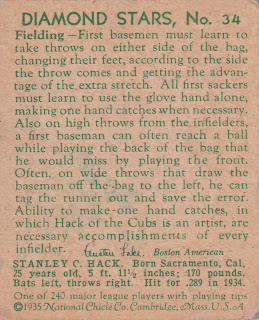
#34 Stanley Hack - Chicago Cubs


Stanley Camfield Hack
Chicago Cubs
Third Base

Bats:
  Left  Throws:  Right  Height:  6'0"  Weight:  170
Born:  December 6, 1909, Sacramento, CA
Major League Teams:  Chicago Cubs 1932-1947
World Series Appearances:  Chicago Cubs 1932, 1935, 1938, 1945
As a Manager:  Chicago Cubs 1954-1956; St. Louis Cardinals 1958
Died:  December 15, 1979, Dixon, IL (70)

The popular Stan Hack, nicknamed "Smiling Sam," played his entire 16-year big league career with the Cubs and was regarded as one of the best third baseman of his era.  Hack was a mainstay in the Cubs line-up between 1934 and his retirement in 1947, and he seemed to get better as he aged.  He led the league in hits twice (1940 and 1941) and was a five-time All-Star, leading off and starting at third base for the National League squad in 1938, 1939, 1941 and 1943.  Hack earned MVP votes in seven straight seasons between 1938 and 1945, finishing as high as seventh place in 1938.  He helped lead the Cubs to four different World Series during his playing days, and while the Cubs would be defeated in each of those series, Hack batted .348 (24 for  69) in 18 total postseason games.  He tallied over 100 runs scored in seven seasons and led the league in stolen bases in 1938 and 1939.

Hack was also a solid defensive third baseman, leading the league in putouts five times, assists twice and fielding percentage twice.  He retired with a lifetime .301 average, 2,193 hits and 165 stolen bases.  Hack's 1,944 putouts at third base are currently 15th all-time.  Following his playing days, Hack was a minor league manager with several stops in the 1940s, 1950s and 1960s.  He managed the Cubs for three years, beginning in 1954, but they finished with losing records each season.  Hack served as a batting coach for the Cardinals in 1957 and 1958, and took over the club for the final ten games of the 1958 season when manager Fred Hutchinson was fired.  Hack was among the many members of the inaugural Cubs Hall of Fame class in 2021.

Building the Set
January 21, 2022 from Key West, FL (Quality Baseball Cards) - Card #41
Mid-January is never a fun time for me, and needing a break during a long work day I found myself on eBay looking for the remaining Dick Bartell (#15 and #101) variations I needed.  I had recently added his most commonly found card from the set, noting his team as the Giants on the back, but I wanted to try to find his other two cards from the set as well.  

In my travels, I found what I considered to be extremely unusual for this pandemic-induced collecting age - a large group of auctions from seller quality*cards from the Diamond Stars set with no bids, including the elusive Bartell card from the set's third series.  I set my opening bids, and waited a few days for the auctions to close.  Again, much to my surprise, there was little to no action on the auctions until their closing minutes.  I lost a few auctions as the seconds ticked away, but I came away with six new cards overall, including this Hack card for $44.

Variations Available
1 - 1935 / green back / 1934 statistics / 1935 copyright

The final 12 cards in the Diamond Stars set, released as part of series three in 1936, contain the exact same photos and players as earlier cards from the set.  Hack shows up again as card #107, with the same text on the back save for his 1935 statistics at the bottom replacing his 1934 statistics.  Also, the ink on the back of card #107 is blue, similar to all cards from the third series.

The Card / Cubs Team Set
I probably don't spend enough time in these posts discussing the background of each card, but I'll take time here to appreciate the fantastic background on Hack's card.  The yellow cloud, blue sky and reddish city scape make this truly a wonderful looking baseball card.  There's a strangely chosen tip on the back of this card for Hack, as we're taught how a first baseman should position himself at the bag in order to make sure he catches all throws from his infielders.  Hack played 1,879 games on defense during his career, appearing at first base a grand total of 47 times, including 11 times in 1936 and 18 times in 1944.  When this card came out, he had not yet played an inning at the position.

1935 Season
In his fourth season in the majors, Hack would appear in a then career-high 124 games, batting .311 with 133 hits.  He drew 65 walks to only 17 strikeouts, the lowest total of the Cubs regulars.  He was one of the Cubs' most productive hitters, along with catcher Gabby Hartnett (#134), second baseman Billy Herman (#136) and outfielder Augie Galan.  Chicago would win 21 games in a row to stun the front-running Cardinals and Giants and capture the National League pennant.  They'd fall to the Tigers in the 1935 World Series in six games, and Hack slumped in the series, hitting only .227 (5 for 22).

1934-36 Batter-Up (R318) #137
1941 Double Play #3
1955 Topps #6
1961 Fleer Baseball Greats #110
1991 Conlon Collection TSN #126

Other Notable Baseball Cards
First Mainstream Card:  1934-36 Batter-Up (R318) #137
Topps Flagship Set Appearances (1):  1955
Most Recent Mainstream Card:  1991 Conlon Collection TSN #126

58 - Hack non-parallel baseball cards in the Beckett online database as of 1/23/22.

Sources:

Sunday, January 16, 2022

#15 Dick Bartell - New York Giants (Variation)


Richard William Bartell
New York Giants
Shortstop

Bats:
  Right  Throws:  Right  Height:  5'9"  Weight:  160
Born:  November 22, 1907, Chicago, IL
Major League Teams:  Pittsburgh Pirates 1927-1930; Philadelphia Phillies 1931-1934; New York Giants 1935-1938; Chicago Cubs 1939; Detroit Tigers 1940-1941; New York Giants 1941-1943, 1946
World Series Appearances:  New York Giants 1936-1937; Detroit Tigers 1940
Died:  August 4, 1995, Alameda, CA (87)

An aggressive and fiery competitor, Dick Bartell was a veteran of 18 big league seasons, known for his ability to hit for average and his above average defense at shortstop.  Bartell played his first four seasons with the Pirates, making his big league debut at the age of 19.  He blossomed with the Phillies, serving as one of the few bright spots on an otherwise bleak roster.  Bartell led the league in 1932 and 1933 in sacrifices and was one of the Phillies' first All-Stars in 1933.  Bartell started and played shortstop in the first ever All-Star Game, joining teammate Chuck Klein (#139) who started in right field.  Dealt to the Giants following the 1934 season, Bartell would enjoy his finest seasons in New York.

He helped the club reach the World Series in 1936 and 1937, although they fell to the Yankees both times. Those were Bartell's best seasons as he batted .298 with 42 RBIs in 1936 and .306 with 14 home runs and 62 RBIs in 1937.  Despite his numbers, Bartell's combative disposition led to his frequent trades and he also led the league in getting hit by pitches a stunning five times.  He'd return to the Giants for five games in 1946, after serving two years in the Army during World War II, and then retire as a player.  Bartell played in 2,016 big league games and had a lifetime average of .284 with 2,165 hits.  He led all shortstops in putouts and assists in three seasons and in double plays turned in four seasons, and his name is often mentioned as one of the best, and most underrated, shortstops of his era.  His lifetime fielding percentage was .952.  Bartell managed in the minor leagues in the 1940s and 1950s, and served on the big league coaching staffs of the Yankees (1946), Tigers (1949-1952) and Reds (1954-1955).

Building the Set
January 13, 2022 from Tomball, TX (The Battersbox) - Card #38
This card entered my set in error, as I was specifically shopping for the Bartell Phillies card - see below for Variations Available.  Having recently won an auction for the Louis Chiozza (#80) card, which has yet to arrive in the mail as of this writing, I wanted to get closer to a Phillies team set and I specifically set out looking for Bartell's Phillies card.  Finding the card shown here at a reasonable price from The Battersbox, I clicked Buy It Now, and sat back satisfied I had crossed a pair of Phillies cards off my set's checklist in one day.  Fast forward a few days later, this card arrives, and I realize the Bartell Phillies card is still needed.  The Bartell Giants card, at least the first one in the set, has been crossed off the list.

Variations Available
1 - 1934 / green back / 1933 statistics / 1934 copyright / team on back is the Phillies
2 - 1935 / green back / 1934 statistics / 1934 copyright / team on back is the Giants ✅

The Card / Giants Team Set
This is the first of three Bartell cards I'll be adding to my set.  The first two are both #15, with the version released in 1934 noting his team as the Phillies on the back.  The version released in 1935 (this version) updates the back to reflect his trade to the Giants.  Finally, Bartell is also card #101 in the set, and that version, released in 1936, removes the Phillies logos from the photo on the front.  The tip on the back of the card explains the need for a shortstop to vary his throws depending on the angle of a batted ground ball and the speed of the baserunner.

1935 Season
On November 1, 1934, the Phillies traded Bartell to the Giants for Pretzel Pezzullo, Blondy Ryan (#40), Johnny Vergez (#21), George Watkins and cash.  Similar to what they did for Bartell, National Chicle also updated Vergez's card to donate his move from the Giants to the Phillies between their 1934 and 1935 issuances of his card.  Bartell started 135 games at shortstop for the third place Giants, batting .262 with 14 home runs and 53 RBIs.  The 14 home runs would set a career high mark for Bartell, which he tied in 1937.

Phillies Career
The Phillies acquired Bartell from the Pirates on November 6, 1930 for Tommy Thevenow and Claude Willoughby.  With the nickname "Rowdy Richard," Bartell was perhaps the first in a long line of scrappy shortstops to come through Philadelphia.  He was the team's opening day and primary shortstop between 1931 and 1934, establishing himself as one of the best at that position in the game.  Bartell led all National League shortstops in assists in 1932 and 1934, in putouts between 1932 and 1934, and was in the top ten for fielding percentage between 1932 and 1934.  Named as the starting shortstop for the first All-Star Game in 1933, Bartell batted seventh and went 0 for 2, striking out in his first at-bat against Lefty Gomez (#118).  In 587 games with the Phillies, Bartell batted .295 with 695 hits, 386 runs scored, 146 doubles and 161 RBIs.  As mentioned above, he was dealt to the Giants following the 1934 season.

1933 Goudey #28
1933 George C. Miller (R300)
1933 Tattoo Orbit (R305)
1938 Goudey Heads-Up #272
1955 Bowman #234

Other Notable Baseball Cards
First Mainstream Card:  1933 Goudey #28
Topps Flagship Set Appearances (0):  N/A
Most Recent Mainstream Card:  1994 Conlon Collection TSN #1243

64 - Bartell non-parallel baseball cards in the Beckett online database as of 1/15/22.

Sources:

Sunday, November 21, 2021

#111 Phil Cavarretta - Chicago Cubs


Philip Joseph Cavarretta
Chicago Cubs
First Base

Bats:
  Left  Throws:  Left  Height:  5'11"  Weight:  175
Born:  July 19, 1916, Chicago, IL
Major League Teams:  Chicago Cubs 1934-1953; Chicago White Sox 1954-1955
World Series Appearances:  Chicago Cubs 1935, 1938, 1945
As a Manager:  Chicago Cubs 1951-1953
Died:  December 18, 2010, Liburn, GA (94)

Phil Cavarretta made his debut with the Cubs a few months after his 18th birthday, and he spent the next 22 years compiling an impressive playing career in Chicago.  He was a regular with the Cubs from the mid-1930s until the late-1940s, playing first base and all three outfield positions.  Cavarretta enjoyed a career resurgence in the mid-1940s after missing significant time between 1938 and 1940 with a hip injury and a broken ankle.  He made his first of three All-Star teams in 1944, and also led the league that season with 197 hits.  In 1945, Cavarretta won the league's batting title with a .355 mark and was named the National League MVP.  He batted .423 in the 1945 World Series, although the Cubs lost in seven games to the Tigers.  Towards the end of his time with the Cubs, Cavarretta served as the team's player-manager between 1951 and 1953, guiding the team to a 169-213 record and finishing as high as fifth place in 1952.  He spent a final two seasons playing for the White Sox before retiring.  Cavarretta appeared in 2,030 games, collecting 1,977 hits while batting .293.  His 1,927 hits while with the Cubs are currently 10th on the franchise's all-time leader's list, and he was the all-time Cubs leader in games played with 1,953 before Ernie Banks surpassed the mark in 1966.

Cavarretta managed in the minor leagues between 1956 and 1958, and again between 1965 and 1972.  He'd later serve as a major league coach for the Tigers (1961-1963) and Mets (1975-1978).  Cavarretta is a member of the Chicago Cubs Hall of Fame.

Building the Set
December 11, 2020 from San Diego, CA (Kit Young Cards)
On the night I impulsively decided to collect the original Diamond Stars set, and I subsequently purchased the Harvey Hendrick (#41) card from Kit Young Cards, I also added the complete, and first, extended set to my cart for the very reasonable price of $7.50.  The 12 cards in this first extended set were originally issued in 1981.

In the early 1980s, a family member of a former National Chicle employee discovered an uncut sheet of 12 unused cards presumably meant as a 1937 continuation of the Diamond Stars set.  As originally advertised, and as mentioned on the back of every card issued, the company had intended for the set to contain 240 subjects.  They only produced 108 cards before production was halted, and the theory is this newly found sheet represented a "lost" continuation of the set.  Fortunately, the images of the cards made their way into the collecting world and a 12-card "what if" set was created.  (More on the uncut sheet can be found here from SABR's Baseball Cards Research Committee and from this Ryan Cracknell article for Beckett.)

The Beckett online database lists the set as "1981 Diamond Stars Continuation Den's" and the set's description notes "This set was created and produced by Denny Eckes.  Hobbyist Mike Galella was involved in bringing this sheet to the the public.  These cards were originally available from the producer for $3."  The back of the cards have a 1981 copyright attributed to Den's Collectors Den, the company belonging to the aforementioned Eckes.  I found the ad shown here within the pages of the The Sport Americana Baseball Card Price Guide, published in 1982.

The 12 cards include more ambitious geometric designs than the original Diamond Stars cards,  although the overall color template remains the same as their 1934 to 1936 counterparts.

Variations Available
1 - 1981 / blue back / 1936 statistics / 1981 copyright

The Card / Cubs Team Set
This card, along with most of the contemporary cards issued for Cavarretta in the 1930s and 1940s, misspell his name with only one "R."  The text on the back of the card refers to how young Cavarretta was (20 years old as of July 19, 1936) and that he had only spent the 1934 season playing in the minor leagues.

1937 Season
The Cubs finished in second place in the National League, three games behind the pennant-winning New York Giants.  Cavarretta saw action in 106 games, making 84 total starts - 40 at first base, 38 in center field and six in left field.  The Cubs players with more starts at each of those positions than Cavarretta were Ripper Collins at first, Joe Marty in center field and Augie Galan in left field, none of whom appeared in the original Diamond Stars set.  Cavarretta batted .286 with five home runs and 56 RBIs.

1934-36 Batter-Up (R318) #101
1941 Double Play #103
1949 Bowman #6
1952 Topps #295
1955 Bowman #282

Other Notable Baseball Cards
First Mainstream Card:  1934-36 Batter-Up (R318) #101
Topps Flagship Set Appearances (2):  1952, 1954
Most Recent Mainstream Card:  2014 Panini Golden Age #89

79 - Cavarretta non-parallel baseball cards in the Beckett online database as of 10/22/21.

Sources: